Why AI Writing Sounds Robotic: 9 Patterns and How to Fix Each
AI drafts rarely fail because they are wrong. They fail because they are frictionless. Nine patterns, a before-and-after for each, and the order to fix them in.
Most AI-written text is not wrong. That is the confusing part. The grammar is clean, the structure is orderly, the claims are usually defensible. And yet readers put it down after two paragraphs and cannot say why.
The reason is friction, or rather the absence of it. Human writing has resistance in it: a writer choosing between two words, deciding a point is worth pressing, cutting a sentence that almost worked. That struggle leaves marks on the page, and those marks are what make prose feel like it came from someone. AI drafts are frictionless. Every sentence arrives at roughly the same length, hedged to roughly the same degree, balanced against a counterpoint that nobody asked for.
Below are nine patterns that produce that effect, each with a before-and-after example. The fixes are mechanical, which is good news: you can learn to spot them in a single reading pass.
1. Uniform sentence length
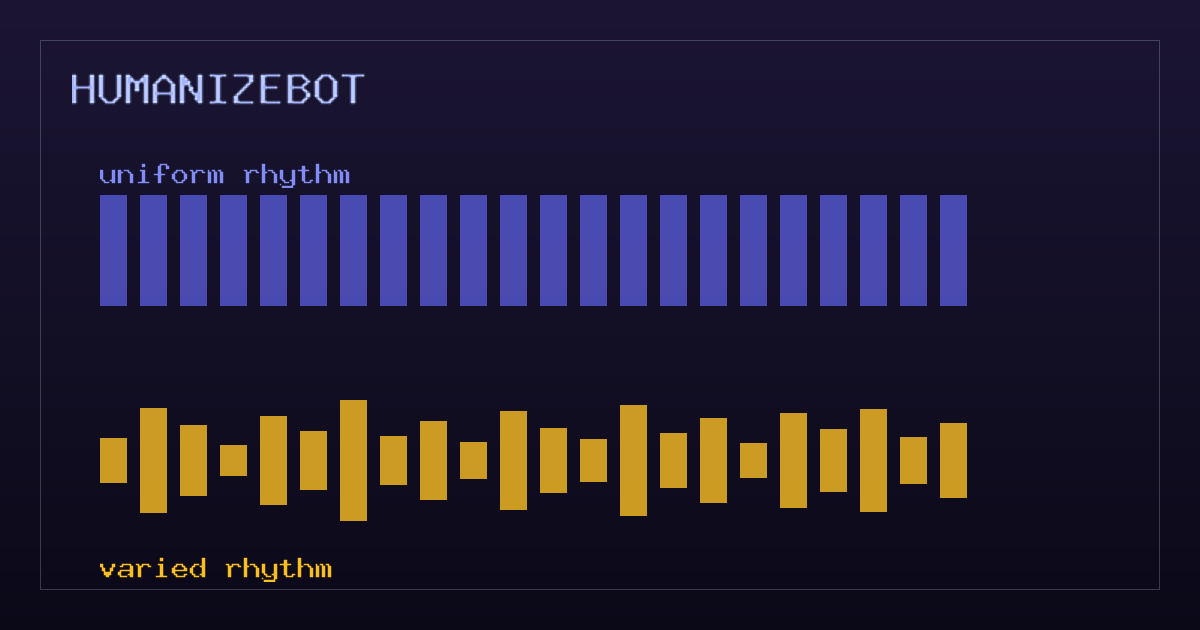
Model output clusters around fifteen to twenty-two words per sentence and stays there. Nothing is individually wrong. The cumulative effect is a metronome.
Before: "The company introduced a new onboarding process in March, which was designed to reduce the time required for new employees to become productive. The results have been positive across most departments, with average ramp-up time falling by several weeks. Managers have reported higher satisfaction with the quality of preparation among new hires."
After: "The company rebuilt its onboarding process in March. The goal was simple: get new hires productive faster. It worked. Average ramp-up time fell by several weeks in most departments, and managers say the new arrivals turn up better prepared."
The fix is arithmetic. Find your longest sentence in a paragraph and your shortest. If the gap is under ten words, break one sentence in two and let a short one land hard.
2. Hedging on every claim
Models are trained to avoid overstating, so qualifiers accumulate: may, might, could, often, generally, in some cases, it is worth noting that. One hedge signals care. Four in a paragraph signal that the writer has no position.
Before: "It could be argued that remote work may potentially offer some benefits for certain types of employees, though results can often vary depending on a range of factors."
After: "Remote work suits people whose output is measurable and whose collaboration is asynchronous. It suits junior staff badly, because they learn by overhearing."
The fix: keep hedges only where you are genuinely uncertain, and delete the rest. If deleting a hedge makes the sentence false, keep it. If it just makes the sentence braver, delete it.
3. Empty intensifiers
Words that are supposed to add force but add only syllables: very, incredibly, truly, significantly, highly, extremely, remarkably, absolutely essential, critically important.
Before: "Choosing the right supplier is absolutely critical, and getting this decision wrong can be incredibly costly for growing businesses."
After: "Choosing the wrong supplier costs you twice: once for the bad stock, and again for the three months it takes to replace them."
The fix: delete the intensifier and check whether the sentence lost anything. Usually it did not. If the point genuinely needs force, supply the force with a specific detail rather than an adverb.
4. The "not only X but also Y" construction
This is the single most recognisable tic in AI prose, along with its relatives: not just A but B, while X, it is also Y, more than just X. It manufactures the shape of an insight without the content of one.
Before: "The new curriculum not only improves student engagement but also strengthens critical thinking skills across all year groups."
After: "The new curriculum keeps students engaged. More usefully, it makes them argue with the reading instead of summarising it."
The fix: split the sentence. State the first thing. State the second thing. If both are true and neither is surprising, cut one.
5. Tricolon overuse
Lists of three are genuinely good rhetoric, which is why models produce them constantly. Clear, concise and compelling. Faster, cheaper and more reliable. When every paragraph carries one, the pattern becomes visible and stops working.
Before: "A good proposal is clear, persuasive and well-researched. It should address the client's needs, demonstrate your expertise and outline a realistic timeline."
After: "A good proposal answers the question the client actually asked. Everything else, including your credentials and your timeline, is supporting material."
The fix: count the three-item lists in your draft. Keep the best one. Convert the others into a single strong item or a genuine four-item list.
6. Abstract nouns instead of concrete ones
AI prose gravitates toward category words: solutions, strategies, approaches, frameworks, initiatives, factors, aspects, considerations, capabilities. These are placeholders where a specific thing should be.
Before: "Organisations should implement comprehensive strategies to address the various challenges associated with data management in modern operational environments."
After: "Decide who owns each database, write down where the backups live, and test a restore once a quarter. Most data disasters are failures of ownership, not technology."
The fix: for every abstract noun, ask "such as what?" If you cannot answer, the sentence is empty and should go. If you can answer, replace the abstraction with the answer.
7. Restating the question before answering it
A habit inherited from chat formatting. The first sentence of a section repeats the heading in declarative form, which costs the reader a sentence and gains them nothing.
Before (under the heading "How long does registration take?"): "The question of how long registration takes is one that many applicants ask, and the answer depends on several factors. Registration typically takes between two and three weeks."
After: "Two to three weeks, if your documents are complete. Six weeks or more if the notarised translation is missing, which is the usual delay."
The fix: delete the first sentence of every section and see whether anything was lost. In AI drafts, roughly half the time nothing was.
8. Conclusions that summarise instead of landing
The default closing paragraph restates the article in compressed form: "In conclusion, we have examined several key aspects..." Readers who reached the end do not need a recap. They need the point the whole piece was building toward.
Before: "In conclusion, effective inventory management involves several important considerations. By understanding demand patterns, maintaining appropriate stock levels and building strong supplier relationships, businesses can position themselves for long-term success."
After: "Most inventory problems are forecasting problems wearing a costume. Before you buy software, spend a month writing down what you thought you would sell and what you actually sold. The gap will tell you more than any system."
The fix: cut the summary. Ask what you would say if you had one more sentence and the reader was already convinced. Write that.
9. Perfectly balanced paragraphs
Each paragraph opens with a topic sentence, develops it across two or three sentences, and closes with a transition. Every paragraph is four to five sentences. The uniformity is a stronger tell than any individual word choice, because it signals that no idea was allowed to be bigger or smaller than any other.
Before: Three consecutive paragraphs of roughly ninety words, each beginning "Another important consideration is...", "Additionally, businesses should note...", "Furthermore, it is worth considering...".
After: One paragraph of one hundred and forty words on the thing that actually matters, followed by a two-sentence paragraph on the thing that does not, followed by a one-sentence paragraph that turns the argument.
The fix: give your most important idea the longest paragraph and your least important idea the shortest. Let at least one paragraph be a single sentence.
Fix them in this order
These nine problems are not equally expensive to fix, and some fixes make others unnecessary. Working in this order saves the most time:
- Abstract nouns (pattern 6) first. This is a content problem disguised as a style problem. Replacing abstractions with specifics often deletes whole paragraphs, which means you never have to fix the rhythm of sentences you were going to cut anyway.
- Restated questions and summary conclusions (patterns 7 and 8). Both are structural deletions. Do them before any line editing, for the same reason.
- Hedges and intensifiers (patterns 2 and 3). These are search-and-delete operations. Build a list of your own repeat offenders and run through it mechanically.
- The "not only" construction and tricolons (patterns 4 and 5). Specific constructions, easy to search for, quick to rewrite once found.
- Sentence length and paragraph balance (patterns 1 and 9) last. Rhythm is the final pass because it depends on what survived every earlier cut. Polishing rhythm first means polishing sentences you will later delete.
What this does not fix
Every pattern here is about surface. Fixing all nine produces text that reads like a competent human wrote it, which is a real improvement and often enough for a blog post or an internal report.
It does not add an argument the draft never had. It does not verify a single claim. It does not supply the example from your own experience that would make the piece worth reading rather than merely readable. Those require knowing something the model does not, and no editing checklist substitutes for that.
If you want the surface fixed quickly, a tool such as an AI humanizer handles the mechanical patterns in seconds. The judgement calls, deciding which paragraph carries the weight and which claim you are willing to stand behind, stay with you.
More from the blog
Using AI for a Literature Review Without Wrecking It
AI has a real role in a literature review, and it sits later than most people put it: afte...
Flagged as AI for Writing in Your Second Language: What to Do
It is not your imagination. Detectors score vocabulary range, not authorship, and a peer-r...
Does Google Penalise AI Content? What the Policies Actually Say
No, Google does not penalise AI-written content. It penalises pages published at scale to...
