Does Google Penalise AI Content? What the Policies Actually Say
No, Google does not penalise AI-written content. It penalises pages published at scale to manipulate rankings, whoever or whatever wrote them. The distinction is the whole story.
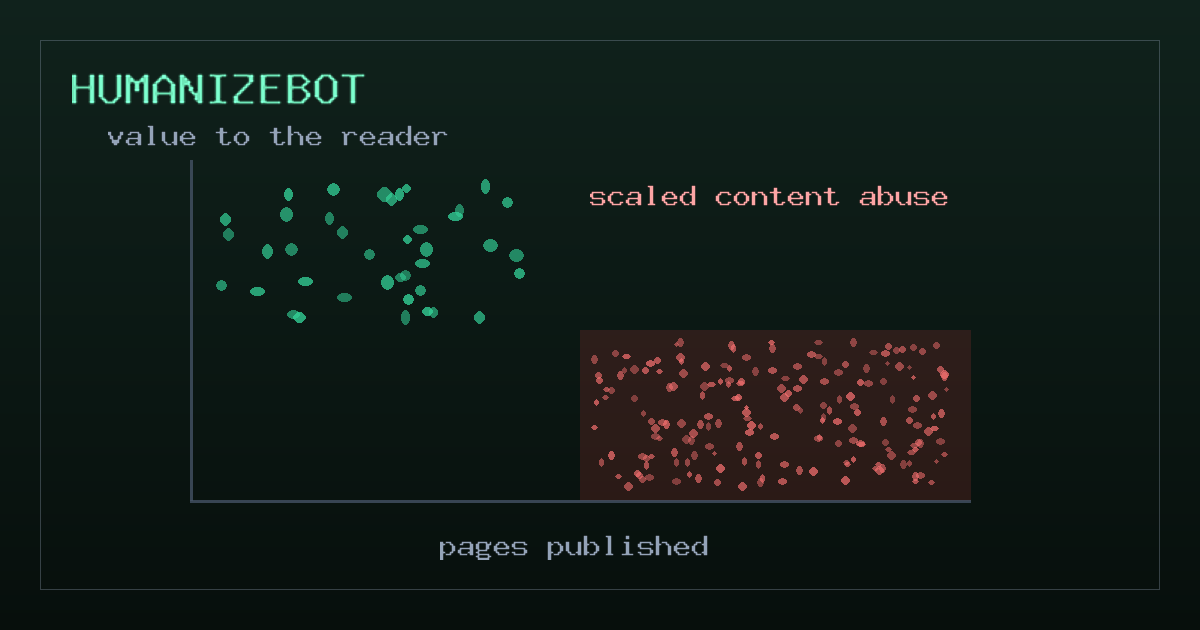
The short answer is no. Google does not apply a penalty to content because a machine helped write it. There is no AI filter, no origin check, and no ranking demotion triggered by detecting generated text. What Google does target is a behaviour — producing large volumes of pages primarily to game search rankings rather than to help anyone — and that behaviour is penalised identically whether a person, a script, or a language model produced the pages.
The confusion is understandable. Plenty of sites publishing AI content have lost traffic, and it is tempting to draw a straight line from cause to effect. But the sites that got hit share a different common feature, and once you see it, the policy makes a lot more sense.
What Google actually says
Google's stated position, published in its Search Central guidance on AI-generated content, is that it rewards high-quality content however it is produced. The emphasis is on quality, originality, and usefulness to people — not on the production method. The company's framing is that using automation to generate content primarily for ranking manipulation has always violated its spam policies, and that this is unchanged by the arrival of better generation tools.
Note the phrase "primarily for ranking manipulation." That is the hinge the entire policy turns on. Intent and outcome are what get judged. A page that exists to answer a real question is fine. A page that exists because a keyword had volume and someone wanted to occupy the slot is not — and never was, going back well before language models were any good.
The March 2024 change: from "automatically generated" to "scaled content abuse"
In March 2024, Google updated its spam policies, and one change is directly relevant here. The policy previously called "spammy automatically-generated content" was renamed and broadened to scaled content abuse.
That rename was not cosmetic. The old wording keyed on the method — automation. That created a loophole and a false comfort at the same time. The loophole: hire twenty underpaid writers to produce the same low-value pages by hand and technically avoid a policy about automatic generation. The false comfort: assume any automated assistance falls under a spam policy.
The new wording keys on scale and purpose instead. Google describes scaled content abuse as generating many pages for the primary purpose of manipulating search rankings and not helping users — and states explicitly that this applies regardless of how the content is created, including by humans.
| Old framing | Current framing | |
|---|---|---|
| Policy name | Spammy automatically-generated content | Scaled content abuse |
| Trigger | Automation | Volume plus manipulative intent |
| Human-written spam | Ambiguous | Explicitly covered |
| AI-assisted quality content | Ambiguous | Explicitly not a violation |
For anyone publishing carefully, the current framing is better news than the old one. It moves the question from "did a model touch this?" — which nobody can answer reliably — to "is this page worth existing?", which you can answer yourself before you hit publish.
E-E-A-T is not a switch you can flip
E-E-A-T — Experience, Expertise, Authoritativeness, Trustworthiness — comes up constantly in this conversation, usually misunderstood. It is worth being precise.
E-E-A-T is a concept from Google's Search Quality Rater Guidelines, the document given to the human contractors who evaluate search results. Those raters do not adjust anyone's rankings. Their assessments are used to evaluate whether changes to Google's ranking systems make results better or worse in aggregate.
So E-E-A-T is not a ranking factor. There is no E-E-A-T score attached to your domain. Google has said as much repeatedly. What it is, is a description of the qualities Google is trying to get its systems to reward. That makes it a genuinely useful lens — just not a checklist you can complete.
The first E, Experience, is the one that matters most for this topic. It asks whether the content demonstrates first-hand involvement with the subject: has the writer used the product, visited the place, run the procedure, made the mistake? This is exactly what a language model cannot supply. A model can produce a competent overview of anything and first-hand experience of nothing. That is not a moral failing of AI; it is a structural fact about what the tool is.
A model can tell you what has been written about a subject. It cannot tell you what happened when you tried it.
Why thin AI content actually fails
When an AI-heavy site loses rankings, the failure is almost never mysterious. It fails on quality grounds that would have sunk equivalent human-written pages just as fast:
- Nothing original. The page restates what the top ten results already say. Search engines have no reason to prefer the eleventh version of a consensus summary.
- No first-hand input. No testing, no data, no photographs, no numbers the author gathered, no opinion informed by having done the thing.
- Published at implausible volume. Four hundred pages in a month from a site with one named author invites scrutiny, and rightly so.
- Keyword-shaped rather than question-shaped. Pages that exist because a phrase had search volume, with near-duplicate variants for every permutation.
- Unverified factual claims. Confident statistics with no source, or citations that do not resolve to real documents.
- No accountability. No named author, no credentials, no contact route, no correction policy.
Every item on that list is a quality problem. None of them is an origin problem. A page written entirely by hand that ticks all six boxes will struggle just as much, and a page written with heavy AI assistance that ticks none of them can do perfectly well.
A practical checklist for publishing AI-assisted content
If you use models in your workflow — and most publishers now do, at least for drafting and structure — these are the checks that actually matter.
Before you write
- Establish why this page should exist. Not "this keyword has volume." What question does it answer that existing results answer badly? If you cannot name the gap, do not fill it.
- Identify what you can add that nobody else has. Original data, a test you ran, a process you documented, a customer pattern you observed, a photograph of the actual thing. If the answer is nothing, the page will be a rewrite of the competition — and it will read like one.
While you write
- Put the experience in explicitly. Specifics beat generalities: what you tried, what broke, what the numbers were, what surprised you.
- Verify every factual claim. Models produce plausible statistics and plausible citations, and plausible is not the same as true. Resolve every DOI, open every source, confirm the paper says what the draft claims it says.
- Cut what you cannot stand behind. If a sentence sounds confident but you do not know whether it is true, delete it. Vague and correct beats specific and wrong.
- Edit the prose properly. Model output has recognisable habits — hedged openings, three-item lists everywhere, uniform paragraph lengths, tidy summary sentences that add nothing. Editing these out makes the writing better to read, and that is reason enough. Whether it changes how a detector scores the text is a separate question; if you want the mechanics of that, our page on what bypassing AI detection actually involves covers it honestly, including the limits.
Before you publish
- Have a real person review it who knows the subject. Not a proofreader — someone qualified to catch a claim that is subtly wrong. Name them on the page if they are willing.
- Attach a real author. A name, a short bio explaining why they can speak to this, and a way to reach them.
- Check the publishing rate. If your output has jumped tenfold and nothing else about your operation changed, that is the pattern scaled content abuse describes, whatever the quality of individual pages.
- Read it as a stranger. Would someone landing here from search get what they came for and leave satisfied? Or would they hit back and try the next result?
What this means in practice
The policy question and the quality question have collapsed into the same question. You cannot be penalised for using AI, so there is no need to hide it and no benefit in pretending. What you can be penalised for is flooding the index with pages nobody needed, and that has been true for as long as search engines have existed.
Use whatever tools make you faster. Then spend the time you saved on the parts a model cannot do — the original observation, the verification, the judgement about what to leave out. That is where the value was all along, and it is the part that holds up regardless of how the policies get worded next.
More from the blog
Using AI for a Literature Review Without Wrecking It
AI has a real role in a literature review, and it sits later than most people put it: afte...
Flagged as AI for Writing in Your Second Language: What to Do
It is not your imagination. Detectors score vocabulary range, not authorship, and a peer-r...
AI Invented a Citation: How to Catch It Before Anyone Else Does
Two lawyers filed a brief citing six cases that did not exist, then asked ChatGPT whether...
