How to Edit a ChatGPT Draft: A 7-Pass Workflow
Editing in one pass is why it takes so long and improves so little. Seven passes, each looking for one thing, with a single paragraph carried through all of them.
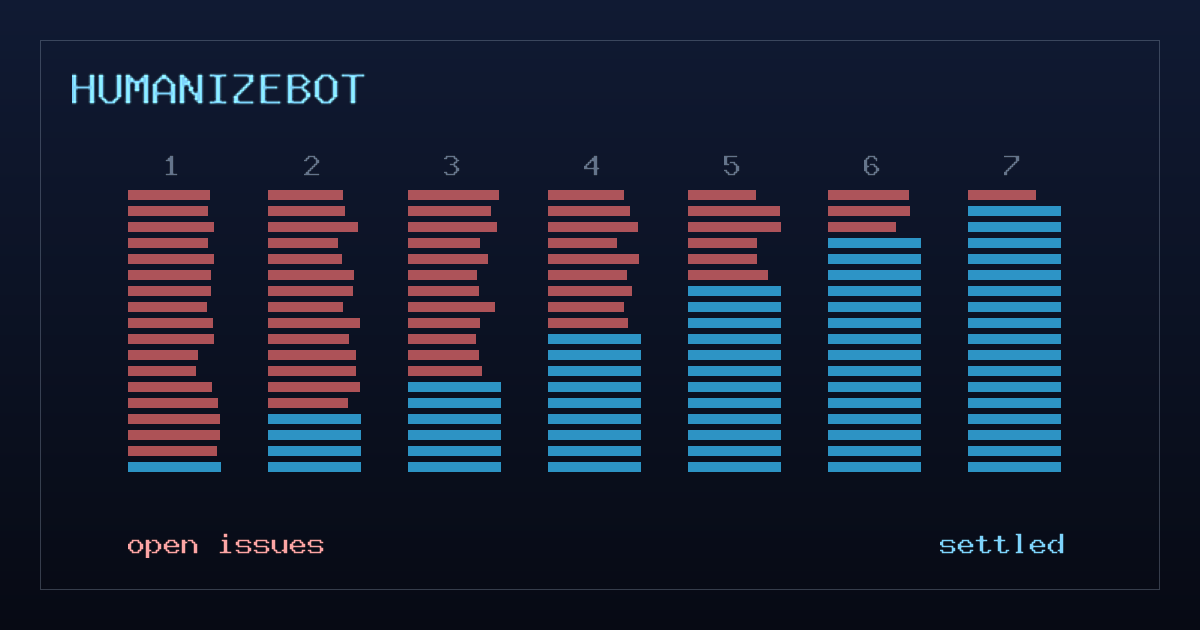
Most people edit an AI draft the same way they edit their own writing: start at the top, read down, fix whatever they notice. That works badly here, and it works badly for a specific reason. An AI draft has problems at every level at once, and trying to catch them all in one reading means you fix a comma in a paragraph you are about to delete.
The alternative is seven passes, each looking for exactly one thing. It sounds slower. It is consistently faster, because each pass is a simple search task rather than an act of general judgement, and because the expensive work happens after the cheap deletions.
One example paragraph runs through all seven passes below. Here it is as the model produced it, from a draft about small businesses adopting accounting software:
Implementing accounting software can offer numerous benefits for small businesses. It is important to note that the transition may present certain challenges, particularly for organisations that have relied on manual processes for an extended period. However, with proper planning and adequate training, most businesses find that the advantages significantly outweigh the initial difficulties. Research suggests that companies adopting digital accounting solutions can reduce bookkeeping time by up to 40%, while also improving accuracy and compliance.
Clean, plausible, and almost entirely hollow. Watch what each pass does to it.
Pass 1: Structure and argument order
Looking for one thing: whether the sections are in the right order and whether each one earns its place.
Do this with the prose collapsed. Read only your headings. AI drafts have a characteristic structural failure: they cover a topic rather than argue a case. Sections appear because they relate to the subject, not because the previous section made them necessary.
Ask three questions of the outline:
- Does each section depend on the one before it, or could they be shuffled without loss? If they shuffle freely, you have a list, not an argument.
- Which section carries the actual point? If it is fourth, it probably belongs second.
- What is missing that a reader would object with? Draft a heading for it now.
Delete whole sections here without mercy. A section deleted in pass one saves you six later passes over it.
Our paragraph: at outline level, this paragraph is doing generic scene-setting under a heading about implementation. The article's actual argument, arrived at in pass one, is that the software choice matters less than the data cleanup before migration. So this paragraph moves from the introduction to the section on transition costs, and its job changes: it now needs to say what the transition actually costs.
Pass 2: Substance and evidence gaps
Looking for one thing: claims with nothing behind them.
Go through the draft and mark every sentence that asserts something. For each, ask: what is the evidence, the example, or the mechanism? AI drafts are dense with assertions that sound informed and rest on nothing, because the model is producing the shape of expertise rather than reporting knowledge.
Three markers to look for specifically:
- Vague attribution: "research suggests", "studies have shown", "experts agree". Either find the actual source or cut the claim.
- Suspiciously round numbers: figures like 40%, 60%, 3x. Models generate plausible-looking statistics readily. Treat every unattributed number as false until you verify it.
- Missing mechanism: a claim that X causes Y without saying how. If you cannot explain the mechanism, you do not know whether the claim is true.
This is also where you add what only you can add: the client who did this and what went wrong, the specific line item on the invoice, the thing you learned the hard way.
Our paragraph: the "up to 40%" figure has no source and cannot be verified, so it goes. "Research suggests" goes with it. In their place, a specific from actual experience: the migration itself takes a weekend, and cleaning up the supplier ledger beforehand takes three weeks. That is the real cost, and it is the thing the paragraph should have said.
Pass 3: Voice and stance
Looking for one thing: whether the text has a position and whether it sounds like you.
Stance and voice are separable but they fail together. AI drafts default to a neutral, institutional register that refuses to prefer anything. Every trade-off is presented as balanced.
The corrective is to state preferences. Which option would you actually pick? What is the common mistake you have seen? What do you disagree with in the standard advice? A reader can disagree with a position. Nobody can disagree with a survey.
On voice: your own writing has habits. Short paragraphs, perhaps, or sentences that start with "and", or a refusal to use the second person. Find two or three pieces you wrote from scratch and read them next to the draft. The differences are your voice.
Our paragraph: the hedged neutrality ("may present certain challenges", "most businesses find") is replaced with an actual position. The stance is that the standard advice about choosing software has the priority backwards.
After passes one to three, the paragraph looks like this:
The migration weekend is not the hard part. Moving your data into new accounting software takes a Saturday. What takes three weeks is the supplier ledger you have to clean first: the duplicate entries, the accounts that were closed in 2019 and never archived, the six spellings of the same courier company. Every business I have seen struggle with this migration struggled with the cleanup, not the software.
Pass 4: Sentence-level rhythm
Looking for one thing: the sound of the prose.
Only now do you touch individual sentences, because only now do you know which sentences are staying. This is the pass where you fix the mechanical tells: uniform sentence lengths, hedges, empty intensifiers, the "not only X but also Y" construction, lists of three in every paragraph.
The practical method is to measure. In each paragraph, check the gap between the longest and shortest sentence. If everything sits between fifteen and twenty-two words, break one and let a short sentence land. Vary how sentences open, too: AI drafts start a high proportion of them with the subject, which gives the whole piece a plodding evenness.
Our paragraph came out of pass three with reasonable variation already, because rewriting for stance naturally breaks the model's rhythm. One adjustment: "Every business I have seen struggle with this migration struggled with the cleanup, not the software" repeats "struggle" awkwardly. Change to: "Every failed migration I have seen failed at the cleanup, not the software."
Pass 5: Fact and citation verification
Looking for one thing: whether each factual claim is true.
Separate from pass two, and it must be. Pass two asked whether a claim has support. Pass five checks whether the support is real. Doing them together means verifying things you were going to cut.
Check every remaining item in this list:
- Every citation. Language models generate references that look correct and do not exist: real author names attached to papers they never wrote, plausible journal titles, DOIs that resolve to nothing. Open each one. A citation you have not opened is a citation you should delete.
- Every number, date and proper noun. Company names, product versions, legislation names, court cases, prices.
- Every quotation. Fabricated quotes attributed to real people are among the most damaging errors a draft can carry.
- Anything time-sensitive. Models have a training cutoff. Prices, rates, policies and feature lists may be out of date even where they were once correct.
Our paragraph has nothing left to verify, because the invented statistic was already removed in pass two. That is the point of the ordering: the fabrications go before you spend time on them.
Pass 6: Formatting, style rules and requirements
Looking for one thing: compliance with whatever rules govern this document.
A mechanical pass with a checklist. Word count within range. Heading hierarchy consistent. Citation format matching the required style. Spelling convention consistent throughout, which matters especially in Bangladesh where drafts often mix British and American forms.
For academic work, read the assignment brief again with the draft next to it and tick each requirement individually. Marks are lost more often to unmet requirements than to weak arguments.
Our paragraph: the courier sentence gets a comma adjustment; British spelling confirmed throughout.
Pass 7: The cold read aloud
Looking for one thing: anything your eye has stopped seeing.
Leave the document for as long as you can afford. Overnight is ideal, an hour is workable. Then read it aloud, start to finish, marking problems without stopping to fix them.
Reading aloud catches what silent reading cannot: sentences that run out of breath, repeated words in adjacent clauses, transitions that do not connect, the paragraph where you lose your own thread. If you stumble while reading, the sentence is broken, even if you cannot say why. Fix your marks in one final sweep.
Our paragraph, final:
The migration weekend is not the hard part. Moving your data into new accounting software takes a Saturday. What takes three weeks is the supplier ledger you have to clean first: the duplicate entries, the accounts closed in 2019 and never archived, the six spellings of the same courier company. Every failed migration I have seen failed at the cleanup, not the software.
Compare that to where it started. It is shorter, it says something specific, it takes a position, and every claim in it is one a person could defend. None of that came from a single clever rewrite. It came from seven cheap decisions made one at a time.
Why the order saves time
The principle behind the sequence is simple: never polish a sentence you are going to delete.
| Pass | Typical share of effort | What it removes or adds |
|---|---|---|
| 1. Structure | 10% | Whole sections |
| 2. Substance | 25% | Empty claims; adds real material |
| 3. Voice and stance | 20% | Neutrality; adds a position |
| 4. Rhythm | 15% | Mechanical tells |
| 5. Verification | 15% | Fabricated facts and citations |
| 6. Formatting | 10% | Rule violations |
| 7. Cold read | 5% | Everything the eye missed |
Passes one to three routinely cut a third of an AI draft. Doing sentence-level work first means doing that work on text that will not survive. Verification sits at five rather than two for the same reason: checking sources is slow, and by pass five only the claims that earned their place are still there.
The other benefit is cognitive. Holding one criterion in mind is easy. Holding seven is not, which is why single-pass editing produces uneven results, with the first two pages heavily worked and the last three barely touched.
An honest note on scope
This workflow takes real time. For a 2,000-word article, expect ninety minutes to three hours depending on how much verification the subject demands. That is considerably longer than most people spend, and it is the reason AI-assisted writing so often disappoints: the draft arrives in thirty seconds and the editing budget gets set to match.
Passes four and six are the most mechanisable, and a tool can compress them. Passes one, two, three and five cannot be delegated to software, because they require knowing the subject and being willing to be wrong in public about it. If you would rather have the whole thing done by a person, our pricing page sets out what that costs. If you are doing it yourself, the sequence above is the part worth keeping.
More from the blog
Using AI for a Literature Review Without Wrecking It
AI has a real role in a literature review, and it sits later than most people put it: afte...
Flagged as AI for Writing in Your Second Language: What to Do
It is not your imagination. Detectors score vocabulary range, not authorship, and a peer-r...
Does Google Penalise AI Content? What the Policies Actually Say
No, Google does not penalise AI-written content. It penalises pages published at scale to...
