AI Invented a Citation: How to Catch It Before Anyone Else Does
Two lawyers filed a brief citing six cases that did not exist, then asked ChatGPT whether they were real. It said yes. Here is how to actually check.
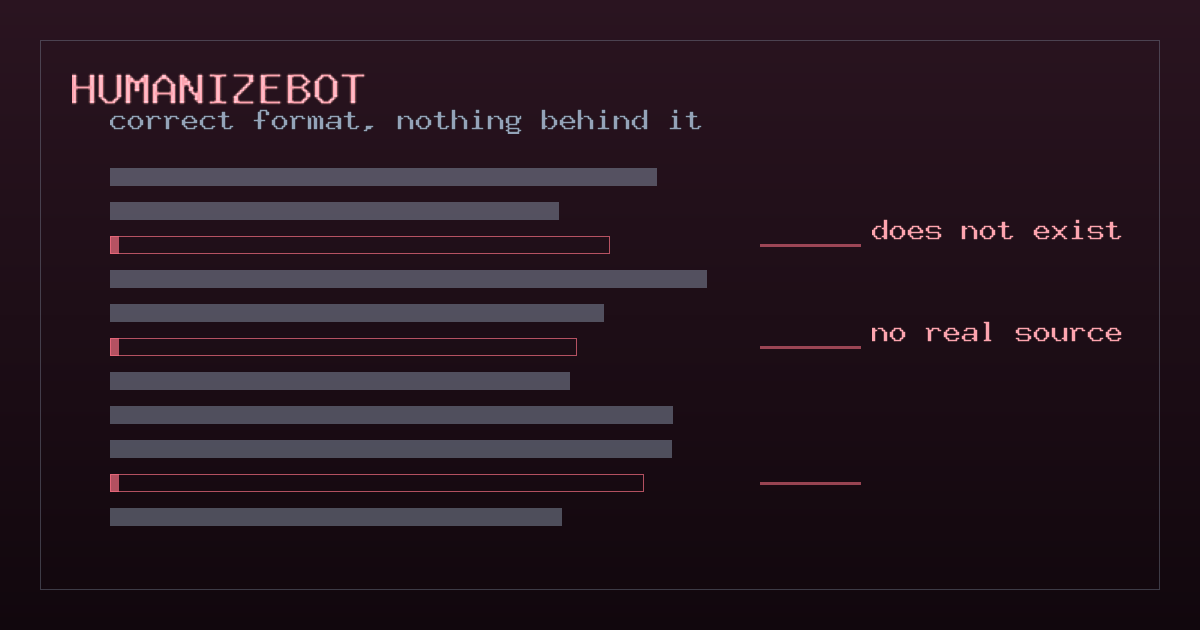
A language model does not retrieve facts. It produces text that is statistically likely to follow the text before it. Most of the time, likely text and true text overlap enough that the output is useful. With citations, they come apart badly — because the model has learned exactly what a citation looks like without any mechanism for checking whether the thing it describes exists.
The result is a reference that is formatted flawlessly, styled correctly, plausible in every visible detail, and completely invented. It will not look wrong. That is the whole problem.
The case everybody should know about
In 2023, in the US federal case Mata v. Avianca, lawyers submitted a brief citing several judicial decisions that did not exist. They had been generated by ChatGPT. When opposing counsel could not locate the cases and the court asked for copies, the fabrication came apart, and the court sanctioned the lawyers involved.
One detail from that episode is worth sitting with. The lawyer had asked ChatGPT whether the cases were real. It said they were. Asked again for confirmation, it confirmed again.
This is not the model lying. It is the model doing exactly what it does: producing the response most likely to follow the question. When you ask "is this case real?", the statistically likely reply is a confirmation, because that is how such exchanges usually go in the text it learned from. The model has no lookup step, no database, no way to check. Its confidence is a property of the sentence, not of the world.
Never ask a model to verify its own output. It has no more access to the truth on the second pass than it did on the first.
The case is worth remembering because these were professionals under scrutiny, with strong incentives to be right. If it can happen there, it can happen in a literature review at midnight.
Why hallucinated citations look perfect
People expect a fake reference to look off somehow — a strange journal name, a mangled format, an implausible year. It almost never does, because the model has absorbed the conventions of academic referencing extremely well:
- Author names follow real conventions. Plausible surnames with correct initials, and often names that genuinely publish in the field — the model has seen them attached to that subject matter thousands of times.
- The journal exists and is the right journal. A fabricated cognitive psychology paper will be placed in a real cognitive psychology journal, not a random one.
- The year is plausible. Recent enough to be relevant, old enough to be cited.
- The volume, issue, and page range look ordinary. Numbers in the ranges those journals actually use.
- The DOI is well-formed. Correct prefix structure, correct publisher registrant code, correct shape. It just does not resolve.
- The title sounds exactly like a real paper. Often it is a recombination of phrasing from two or three genuine titles in the area.
Every surface signal you might use to spot a fake is a signal the model reproduces accurately. Visual inspection cannot catch these. Only checking can.
The five ways fabricated citations fail
They break in a small number of characteristic ways, and knowing the taxonomy makes checking faster because you know what you are looking for.
1. The DOI resolves to nothing, or to something else
The most common failure and the easiest to catch. A DOI is a registered identifier, so it either resolves or it does not. A fabricated one usually returns a "DOI not found" error. Occasionally — and this one is nastier — it resolves to a real but completely unrelated paper, because the model produced a well-formed identifier that happened to already be assigned.
2. The journal is real but the volume, issue, or pages are not
The journal exists. It has been publishing for decades. But volume 47, issue 3 is from a different year than the citation claims, or pages 1122–1140 do not exist in an issue that ends at page 890, or the volume number is simply beyond what the journal has reached.
3. The authors are real, but they never wrote this together
Two or three genuine, currently-publishing researchers in the right field, credited with a paper they did not write. The model has learned who is associated with the topic and assembled a plausible team. This one is particularly awkward socially — you may end up attributing a claim to a living researcher who never made it.
4. The title is a mashup of two real papers
Paper A is "Attentional control in bilingual children." Paper B is "Working memory development across the lifespan." The citation reads "Attentional control and working memory development in bilingual children." It sounds more relevant to your argument than either real paper, which is exactly why it appeared — the model generated the title your context implied should exist.
5. The paper is real, but it does not say what you were told
The most dangerous of the five, because every structural check passes. The DOI resolves. The authors are correct. The journal, volume, and pages are all right. The paper is entirely genuine — and it does not support the claim attached to it. Sometimes it addresses a related question, sometimes it found the opposite result, sometimes it is a commentary rather than a study.
No amount of metadata verification catches this. You have to open the paper and read the relevant part.
| Failure mode | Caught by | How often |
|---|---|---|
| DOI does not resolve | doi.org lookup | Very common |
| Volume or pages wrong | Journal archive check | Common |
| Authors never co-wrote it | Scholar search on exact title | Common |
| Title is a mashup | Scholar search on exact title | Common |
| Paper says something else | Reading the paper | Underestimated |
Four checks that catch nearly everything
Check 1: Resolve the DOI
Paste the DOI at doi.org, or append it to https://doi.org/ in your browser. A real DOI redirects to the publisher's page for that exact article. A fabricated one returns an error.
When it does resolve, read the landing page carefully rather than glancing at it. Confirm the title, authors, journal, and year all match your citation. A resolving DOI pointing at a different paper is a real and easily-missed outcome.
Check 2: Search the exact title in Google Scholar, in quotation marks
Quotation marks matter. Without them, Scholar returns papers with similar words and you will convince yourself something close enough is the paper. With them, you are asking whether this exact title exists.
A real paper returns itself, usually with a citation count and multiple versions. A fabricated one returns nothing, or returns the two real papers whose titles got blended — which is diagnostic in itself. If you see two results that each contain half your title, you have found a mashup.
Check 3: Check the journal's own archive for that volume
Go to the journal's website, find the archive, and open the specific volume and issue. Look at the table of contents. This catches citations where the paper does not exist but the surrounding metadata is convincing, and it catches volume and page errors that the first two checks can miss.
It also settles ambiguity fastest. A table of contents is a definitive list: either the paper is on it or it is not.
Check 4: Open the paper and confirm it supports your claim
The check people skip, and the one that catches the worst failures. Open the actual paper — not the abstract, not a summary, not the model's description of it. Find the specific passage that supports the specific claim you are making. Read the surrounding paragraphs for context.
Watch particularly for: a preliminary or qualified finding cited as established; a hypothesis from the discussion section cited as a result; a study of one population applied to another; and a paper that argues the opposite of your claim while mentioning your claim as the position it disputes.
A useful shortcut
If you cannot immediately find a model-supplied paper, do not spend twenty minutes hunting. Search for the claim instead, in Scholar or your library database, and find a real paper that supports it. Then cite that. It is faster than forensics and produces a better citation — one you have actually read.
Verification checklist
Run this for every reference that came from or through a language model, before it goes anywhere near a submission.
- Paste the DOI into doi.org and confirm it resolves.
- Confirm the resolved page matches your citation on title, authors, journal, and year — not just that something loaded.
- Search the exact title in Google Scholar inside quotation marks.
- Check that the returned result is the same paper, not a near-match with different authors or a different year.
- Open the journal's archive and confirm the volume, issue, and page range exist and correspond to the stated year.
- Open the full text, not the abstract.
- Locate the specific passage supporting your specific claim, and read around it.
- Confirm the paper's actual conclusion is consistent with how you are using it.
- If any check fails, remove the citation. Do not soften it, do not keep it with a hedge — find a real source or drop the claim.
- Never ask the model whether a citation is real. It cannot know, and it will say yes.
Building it into your process
A few habits reduce how often this bites you at all.
- Keep AI-sourced references in a separate list until verified. Mark them, and only move them into your bibliography once they clear the checks. Unverified references drift into final drafts when they are mixed in from the start.
- Verify as you go, not at the end. Checking sixty references the night before a deadline is exactly when checks get skipped.
- Use models for direction rather than sources. Asking what areas of research bear on a question is reasonable — you then find the literature yourself. Asking for a formatted reference list invites fabrication, because you have requested output in a shape the model can produce convincingly and cannot ground.
- Prefer tools that retrieve. Search tools returning links to real indexed documents are a different thing from a model generating a plausible reference. Follow the links either way.
The wider point behind all of this is that AI assistance shifts where your effort goes rather than removing it. Drafting gets faster; verification becomes the part that needs your attention, and it is the part where your name is on the line. If you want more on where machine assistance holds up and where it needs a human, our AI humanizer page covers how we think about that division of labour.
Fabricated citations are one of the few AI failures that is completely solvable. The checks are mechanical, they take a couple of minutes per reference, and they work every time. The only thing that makes them dangerous is skipping them because the reference looked fine — which it always will.
More from the blog
Using AI for a Literature Review Without Wrecking It
AI has a real role in a literature review, and it sits later than most people put it: afte...
Flagged as AI for Writing in Your Second Language: What to Do
It is not your imagination. Detectors score vocabulary range, not authorship, and a peer-r...
Does Google Penalise AI Content? What the Policies Actually Say
No, Google does not penalise AI-written content. It penalises pages published at scale to...
